Why not causation?
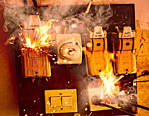
Imagine that an incompetent electrician fails to see that a particular circuit breaker is faulty before installing it in someone’s house. The next day, the homeowner’s family members use more high-wattage appliances than usual, all at the same time. The circuit overloads, the circuit breaker fails, and the circuit panel catches fire. What caused the fire?
Was it the electrician’s incompetence, or the breaker itself, or the way the breaker was made, or the family’s unusually high use of electricity, or something else? The “answer” depends on the interests of whoever asks the question. It’s a question of pragmatics, not metaphysics. That’s why I refrained from using causal language when I defined the metaphysical doctrine of determinism. Instead, I defined determinism by reference to necessitation.
The question of what necessitated the fire depends on few or no pragmatic factors. If we treat the instant of the first electrical spark as the onset of the fire, that instant has a past light-cone:
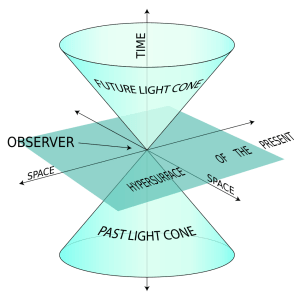
The conditions in any instantaneous horizontal slice (or “hypersurface”) of the past light-cone necessitate the conditions in all later slices, including the slice that contains the spark. Unlike causation, none of this necessitation depends on our interests.
The necessitation of later slices by earlier slices has a noteworthy consequence: All necessitation is indirect, rather than direct. Because time is continuous rather than discrete, no two instantaneous slices are adjacent to each other, just as no two real numbers are adjacent to each other. Therefore, any necessitation between one slice and any later slice goes through infinitely many intermediate slices. No slice ever directly necessitates another. Yet any slice necessitates all later ones.
