Less real?
Chapter 4 of my book defends the claim that the universe is ontologically bottomless, containing no smallest constituents. Any metaphysical substance, such as you, consists of and depends on an infinite series of ever-smaller substances belonging to infinitely many kinds. The only alternative is a universe that eventually makes no sense.
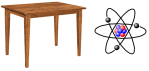
One argument against a bottomless universe employs this premise: Reality comes in degrees, and any substance is less real than the substances on which it depends. For example, a wooden table is less real than the atoms that make it up because the atoms can exist without the table but not vice-versa.
If we grant that premise, then no substance x can depend on an infinite series of ever-smaller substances. Why not? Because, given the infinite length of the series, all of the reality will have “drained away” before x gets to exist to any nonzero degree.
In my book, I reply that the argument’s premise is false and, in any case, it doesn’t imply the argument’s conclusion. As to the premise: No substance is less real than its parts just because it depends on them asymmetrically. While the table exists, the table is just as real as the atoms although it lacks their resilience and longevity.
But even if the premise were true, it wouldn’t establish the conclusion. In a bottomless universe, the reality available to a substance, such as you, need not completely drain away if the degree of reality of substances increases asymptotically as we go down the chain of dependence. In other words, as we move from more dependent to less dependent substances, the difference in their respective degrees of reality approaches but never reaches zero.* Each substance in that infinite series, including you, has some nonzero degree of reality. Therefore, a bottomless universe is possible even if reality comes in degrees.
*Just as the difference between adjacent members of the infinite series ½ + ¼ + ⅛, + … approaches but never reaches zero.
