Bad metaphors
Discussions of determinism often suffer from the influence of bad metaphors. I’ll give some examples from among many I could cite.
In “The Case for Incompatibilism,” philosopher Gideon Rosen writes that if an agent’s failure to do the right thing is necessitated by long-ago conditions, “then it is as if he has been set up to fail.” But how could a situation be merely as if someone has been set up to fail? Either you’ve been set up (by someone) or you haven’t; there’s no in-between. By inserting “as if,” Rosen may hope to hide his conflation of necessitation and manipulation. But the result is a metaphor that makes no sense.
The history of philosophy provides further examples. Epicurus thinks that if determinism is true then each of us is “constrained like a conquered thing.” Holbach says that in a deterministic universe “Man’s life is a line that Nature commands him to describe upon the surface of the earth.” William James writes that in a deterministic universe earlier conditions “appoint and decree” whatever happens later. Using personifying metaphors such as conquest, command, and decree only encourages the mistake we already tend to make of treating all necessitation as if it were manipulation.
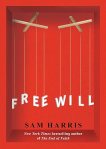
The cover of neuroscientist Sam Harris’s book Free Will is the thumbnail for this post. (Harris thinks we lack free will because he thinks source incompatibilism is true. I criticized source incompatibilism in an earlier post.) The cover shows the letters in “FREE WILL” hanging from puppet strings, as if the truth about how our actions arise shows that we’re puppets rather than agents. But Harris is famously an atheist, so I can’t imagine who he thinks could be pulling our strings. As he himself must see, the metaphor is a bad one.
