Probability and regret
Reader Istvan Csiszar sent an excellent question about determinism and retrospective regret. When we regret that some event E occurred, it’s because we assume that things would be better if E hadn’t occurred. If you regret that you ran over a pedestrian with your car, you assume that you and the pedestrian would both be better off if you hadn’t run him over. I’ve claimed in several posts that your assumption is almost certainly false: If you hadn’t run him over, then almost certainly neither you nor he would have existed at all.
But “almost certainly false” implies “at least possibly true.” Given that your assumption is possibly true, Istvan asks, can’t you rationally regret that the possible scenario in which you and the pedestrian are both better off isn’t the actual scenario? To reply: The less likely a scenario is, the less rational it is to regret that the scenario didn’t happen.
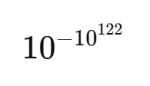
So: Delete the event of your running over the pedestrian and evolve that deletion deterministically backward in time using the laws of motion and statistical mechanics. What’s the chance that you arrive at a “big bang” that will eventually give rise to you and the pedestrian? Roughly speaking, that chance is the number in the box at the top of this post: zero to vastly more decimal places than there are atoms in the known universe. In that sense, then, the degree of rationality in regretting that you and the pedestrian are not better off is about as low as it can be without being strictly zero.
